How do you know what your towing weight is when you leave on your next caravan journey?
Is your car and caravan overweight? Is it underweight? By how much? Is it just right?
How do you really know?
Travelling at 95kmh towards Coffs Harbour on the Pacific Highway, Matt was cruising with just one more hour on the road before his scheduled arrival at the caravan park located right on the beach overlooking Split Solitary Islands.
The caravan was noticeable behind the white DMAX ute. Every time a truck passed by, Matt made a small but necessary correction to keep the caravan from straying in towards the massive B-double on its hurried way to Brisbane. Some bumps and dips in the road would cause a minor pitching movement on the DMAX, again, nothing to be alarmed about, just part of caravanning.
Calm cruising quickly changed to panicked disbelief! The ute instantly felt lighter, raised sharply in the rear, swerved, and picked up speed slightly as the caravan broke off from it’s towball and chains and continued along the Pacific Highway at over 90kph!
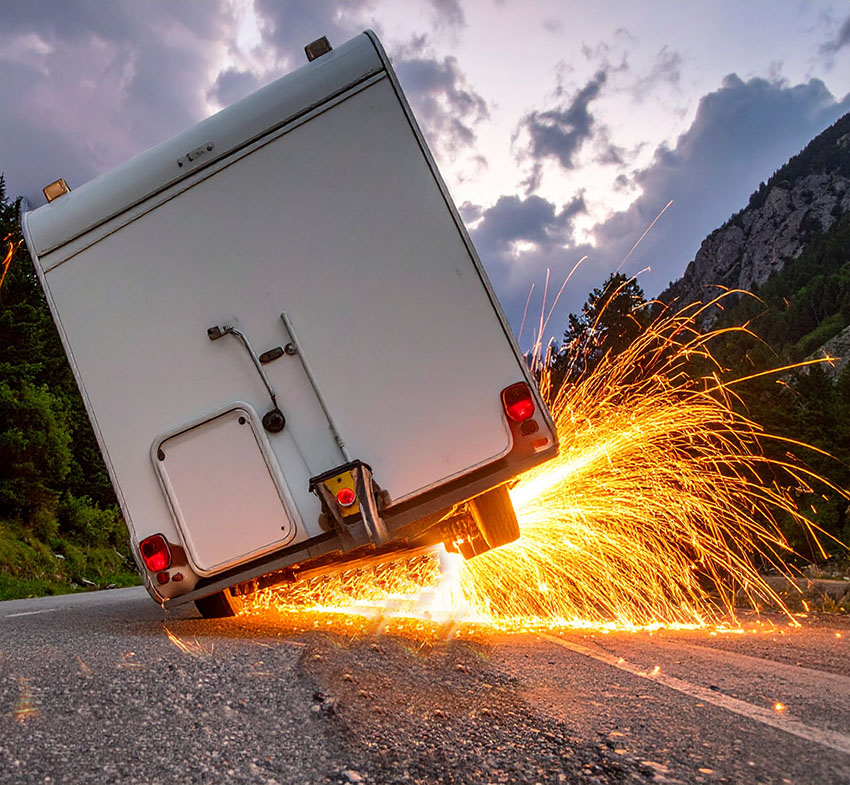
The breakaway cable activated the caravan’s brakes. The caravan bucked and weaved, the drawbar hitting the concrete roadway hard, showering sparks from the shattered hitch.
Even with the brakes activated, the caravan continued completely unguided but slowing, at least. The loose caravan with three thousand kilograms multiplied by 90kph of momentum behind it, uncontrollably rammed the right guardrail, bouncing and instantly heading the opposite way and toward the grassy edge of the highway. The wild, nose-down trailer ploughed into a rocky ditch and tumbled and rolled as the right side wheels were snagged in a deep concrete storm drain. The caravan disintegrated into tiny pieces – just the metal chassis and floor remained, with wheels intact. The upright frame was the only reminder of what was once a travelling holiday home on wheels.
Thankfully, this is a storied example of how caravans are inherently unstable. Caravans have no steering, not even wheels at the front to keep the caravan upright. Without a towing vehicle or even a jockey wheel, a caravan flops heavily to the ground. Without a tow vehicle correcting every sway and bump, a caravan is completely out of control.
Utes and SUVs, while very stable and safe on the road, are near their factory limits. Many vehicles I weigh daily are very close to factory maximums, some even when they are unladen! This means you as the driver will need to ensure everything in your control is pointed towards safety and increasing the safety margins.
Recognising the unstable nature of a caravan, and the limitations of SUV’s and Utes – it’s necessary to do everything possible to increase your safety margins when towing.
A towing vehicle is the caravan’s steering, stability, and master guide.
If a crosswind from a gusty day sends the van sideways a few centimetres, or a truck passes, causing enough pressure to sway the van, your ute or SUV is the only means for the caravan to be guided back in control.
The towing SUV and ute are, in turn, maintained by tiny inputs from the driver’s corrective steering. This is ultimately due to the correct balance between the front and rear axles, and especially the grip on each of the four tyres.
Almost everything to do with the caravan’s stability has to do with the balance and grip on your ute’s tyres. Everything!
Many caravans have stability control and improved axles, but the direction of travel is always from the towing vehicle.
Having weighed over two hundred caravans, four-wheel drives, utes, and SUVs, I can tell you that most are just under maximum weights. A few are over maximums!
Most caravans are less than 100 kgs below maximum by some means. The most likely challenger is the rear axle capacity. Sometimes the hitch is within kilograms of TBM (maximum tow ball weight), or the caravan itself is on or just under maximum ATM!!! It’s not an ideal situation! Most caravans, relying totally on their towing master, that’s the ute or SUV, are just on the brink of being overweight.
Why is it common to be so close to weight maximums?
Manufacturers of both utes and caravans push the limits. Utes have to be as lightweight as possible to obtain fuel economy. Both utes and caravans need to be as luxurious and spacious as possible and with many accessories.
The result is that heavy rigs, are okay to be just on or under the limits. This is how the rigs are engineered, but what is compromised?
Two words: Safety margins.
Consider the stopping distance between a caravan fully loaded to maximum weight, say 3,500 kgs – and the same caravan loaded to 3,000 kgs. I don’t have any data to measure this exactly, but you will agree that the rig weighing 500 kgs more will take longer to stop.
The result is that in an emergency stop – the heavier rig will need additional distance to slow or stop safely.
Cruising speed: Depending on your weight and balance configuration, caravan design, vehicle type, and a long list of many influences, every caravan and tow vehicle has a critical speed.
The critical speed is the point at which the caravan will no longer follow comfortably behind the tow car. This is nearly always evidenced by caravan sway, but enough sway to move the back of the tow car, too, is a major risk.
The critical speed might be 120 kph for one setup, 105 kph for another, as low as 80 kph for a poorly balanced caravan. I have helped the owner of a tool trailer that swayed out of control at only 80 kph. Together, we assessed that a new steel tool rack in the very back of the trailer was the problem. We shifted it to a position over the axles, and stability improved, and the critical speed increased to over 100 kph. Safety margins restored!
Note your critical speed, and also note that your rig’s critical speed will lower with gusty winds, large trucks passing, and slippery roads.
Here is my personal assessment: Driving along the highway, there might be some wobble and sway in the caravan, sending some minor sway in the car. If I can hold the steering wheel perfectly still and straight – and the caravan stays well within the lane, then stability is great. If I need to move the steering wheel more than a centimetre to keep the caravan in the lane, I need to slow down by at least 5 kph. Slow more if necessary. There might be slippery roads, a strong crosswind, or a string of large trucks moving way faster than your rig.
If your rig sways violently – hit the brake controller. Activate the trailer’s brakes first, decelerate with your foot off the accelerator pedal, regain control, and find a safer speed.
Cornering: A caravan weighing 500 kgs more can only ever take a corner at a slower speed. What speed is that? We don’t know, it depends on too many influences: road surface; tyre pressures and tread condition; tyre construction; tow vehicle’s suspension; etc. All you can do is take a sharp curve more carefully than if the caravan were 500 kgs lighter.
How do you increase your safety margins?
- Know your weights.
- Know your balance!
- Ensure tyres, suspension, brakes are checked.
- Drive to the conditions.
Know your weights: Learn about the maximums you can carry. Learn the terms: ATM; GTM; TBM; GVM; GCM; front and rear axle capacities; ride heights.
Get weighed and find your balance. Weighbridges can give you readouts of axles, but usually not tow ball mass. A mobile caravan weighing service can measure the weight of each wheel and the tow ball. Then you know exactly how your rig is balanced. From side to side and front to back.
Drive to the conditions: This comes from experience. A slow first trip leads to learning and experience; then, more comfortable second and third trips with different weight configurations to learn how to get comfortable. Eventually, take a very long trip of 500 kms or more, where you will learn and experience more than any other trip.
Try different cruising speeds, allow yourself plenty of room when overtaking, and especially give yourself plenty of distance for stopping. Hold way back in heavy traffic at speed; slow down way earlier for intersections where you may have to stop or for roundabouts.
Learn to take less on your trip and keep the weights down and safety margins up!
Maybe you can reduce or eliminate the water levels in the freshwater tanks, buy groceries at or near your destination, take less camping gear, fewer books, and fewer clothes. Leave the generator and the extra fridge behind. Make do with an esky. Remember, it’s camping!
If you have the experience, the knowledge, and you know you are within safe limits – go for it! Fill up your rig to the max and enjoy the ride. That’s fine, it is part of caravan freedom. Enjoy the journey and the destination!
Recommendations for learning your towing weights:
- Get weighed professionally from a mobile service.
- Take a guess and load to the maximum. The caravan weighing report will show if you are over or under and where. The caravan weighing professional will advise the best locations for storage, or where to reduce weights.
- Reconfigure. This may mean upgraded suspension, a different towing vehicle, or adjusting the towing hitch. Then return for another weighing session. Gold Coast Mobile Weigh will reduce the fee for the second caravan weigh session.
- In the first instance: set up the LoadMate app when you have your caravan weighed. This app records the exact location of the caravan’s luggage racks, tool boxes, storage cupboards, luggage locations in the vehicle, and more. As you weigh or estimate each item, you can add it to LoadMate, and the app will keep you informed of maximum weights.
If you want to take your caravan away for short trips, or you really love to travel light – then all you need is one weight check. You will find exactly how you are configured. I have had my very own rig with nothing on board, buck and sway. Not out of control, but just uncomfortable. Fiddling with tyre pressures, an anti-sway hitch, and loading soon helped. But it all started with a confidence-boosting caravan weighing session of my own.
Contact me today to discuss your next caravan weighing session or book online right now:
Leave a Reply